
 FIG·01
The twelve deck rail ideas below are sorted by what each one is actually good at, so you can pick by view, budget or upkeep instead of by photo. Cable and glass keep the view. Powder-coated aluminium and composite end the repainting. Pressure-treated wood keeps the cost down. Three numbers stay fixed whichever you choose: deckstore.com puts a residential rail at 36 inches minimum, a commercial rail at 42 inches, and the gap between balusters at no more than 4 inches.
The shortlist:
- View is the point: cable rail or frameless glass
- Upkeep is the point: powder-coated aluminium, composite or perforated metal
- Budget is the point: pressure-treated wood with 2x2 balusters
- The middle: wood posts with black metal balusters
- Wind and privacy: horizontal slats, a half wall or perforated panels
- Close neighbours: a planter-topped privacy rail
Twelve deck rail ideas, and who each one suits
deckstore.com groups railings into seven types: wood, metal, composite, cable, glass, mixed material and DIY. That is a useful map, but it puts every wood rail in one box, and two wood rails can be as different as a stock 2x2 build and a Chippendale panel. Splitting them finer is the whole point of this list.
deckstore.com's own framing holds up: metal is durable and needs minimum maintenance, glass is the luxurious option that gives you the view, and a DIY wooden railing is the cost-effective route.
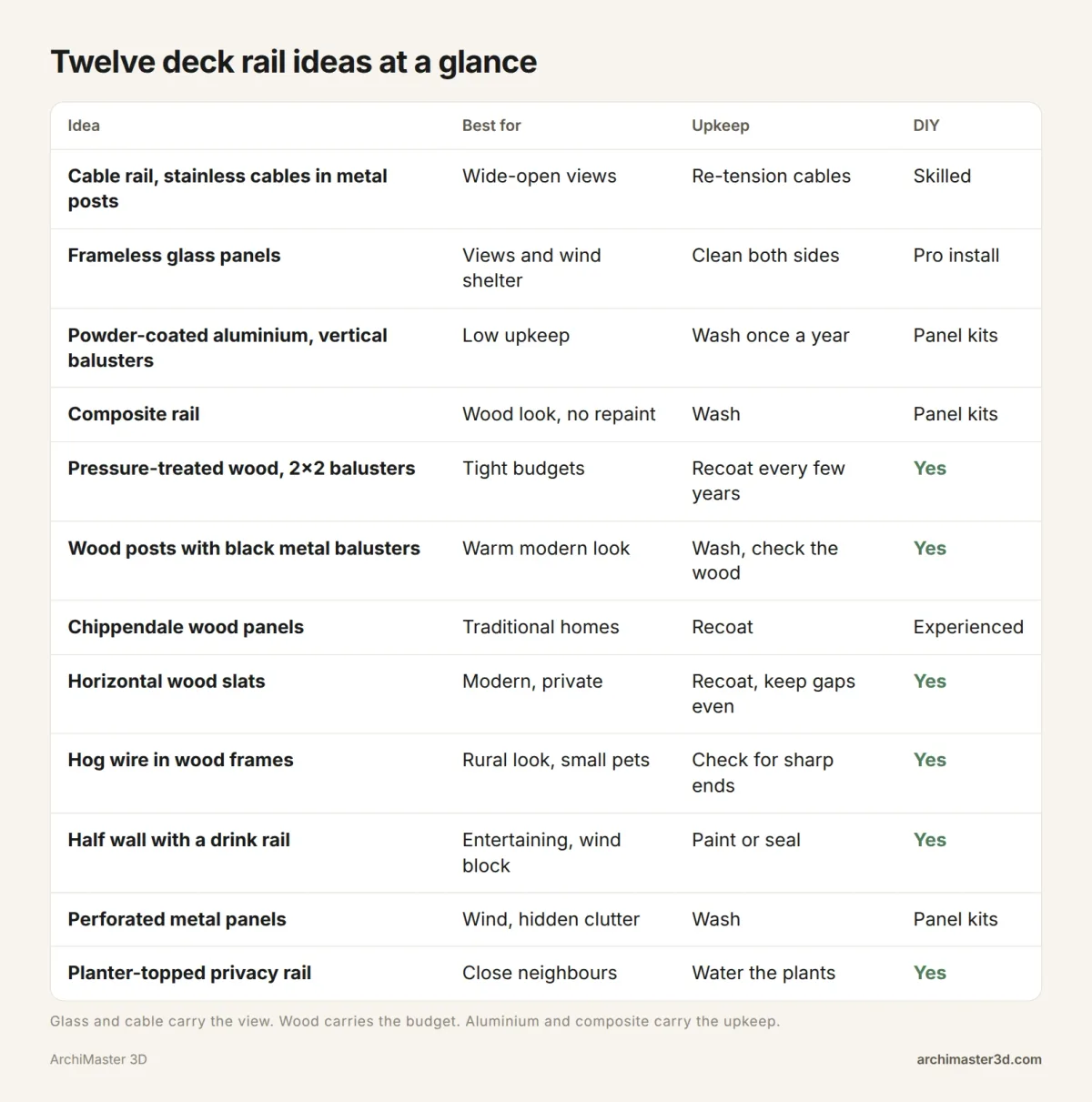
- Cable rail, stainless cables in metal posts: looks like almost nothing, so the view wins. Re-tension the cables now and then.
- Frameless glass panels: invisible until it catches the light, and it cuts wind. Clean both sides.
- Powder-coated aluminium, vertical balusters: thin dark lines, modern. Wash once a year.
- Composite rail: wood look with no repaint. Wash.
- Pressure-treated wood, 2x2 balusters: plain and honest. Recoat every few years.
- Wood posts with black metal balusters: warm top rail, sharp contrast. Wash and check the wood.
- Chippendale wood panels: traditional patterns with diagonals and verticals. Recoat, and an experienced build.
- Horizontal wood slats: modern and private. Recoat, and keep the gaps even.
- Hog wire in wood frames: rural look that holds small pets. Check the cut ends for sharp wire.
- Half wall with a drink rail: wind block plus a ledge for glasses. Paint or seal.
- Perforated metal panels: blocks wind and hides clutter. Wash.
- Planter-topped privacy rail: a green screen at seated height. Water the plants.
Deck rail ideas on a budget
Fewer posts, fewer fittings
The cheapest lever is not the material, it is the post count. One straight run with two corners needs far fewer posts and brackets than a deck with three returns and a stair. Every corner, return and step adds a post, an anchor and a set of fittings.
The stock wood build
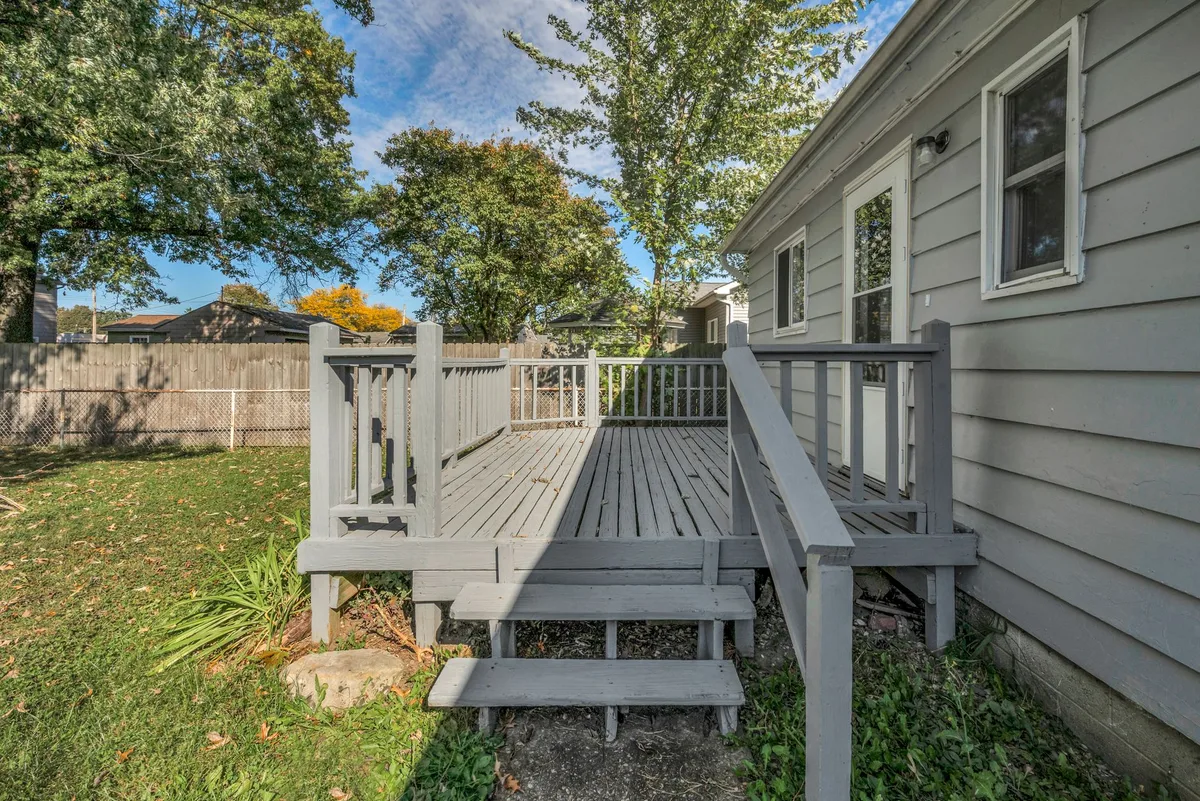
Pressure-treated 4x4 posts, 2x4 top and bottom rails and 2x2 balusters is the standard budget build. deckstore.com calls a DIY wooden railing cost-effective, and this is the version that earns that line. Square balusters beat turned ones on price and on painting time, because one profile means one fitting.
Where the money actually goes
Skip glass and cable on a budget deck. Both push cost into hardware and installation rather than boards. Paint hides mismatched boards today and asks for scraping later; stain shows the grain and needs recoating when water stops beading on the surface. On a budget, spend on posts and anchors, save on infill.
Wood deck rail ideas
Classic square balusters
Square 2x2 balusters under a flat 2x6 top rail is the picture most people have in their head when they say wood deck railing. It is also the easiest to build and the easiest to repair, because one damaged baluster slides out and a new one goes in.
Two-tone wood and metal
Stained or painted posts and top rail with white or black balusters gives one strong contrast line and needs no extra hardware. Black metal balusters on a wood frame is the version that looks deliberate rather than half-finished.
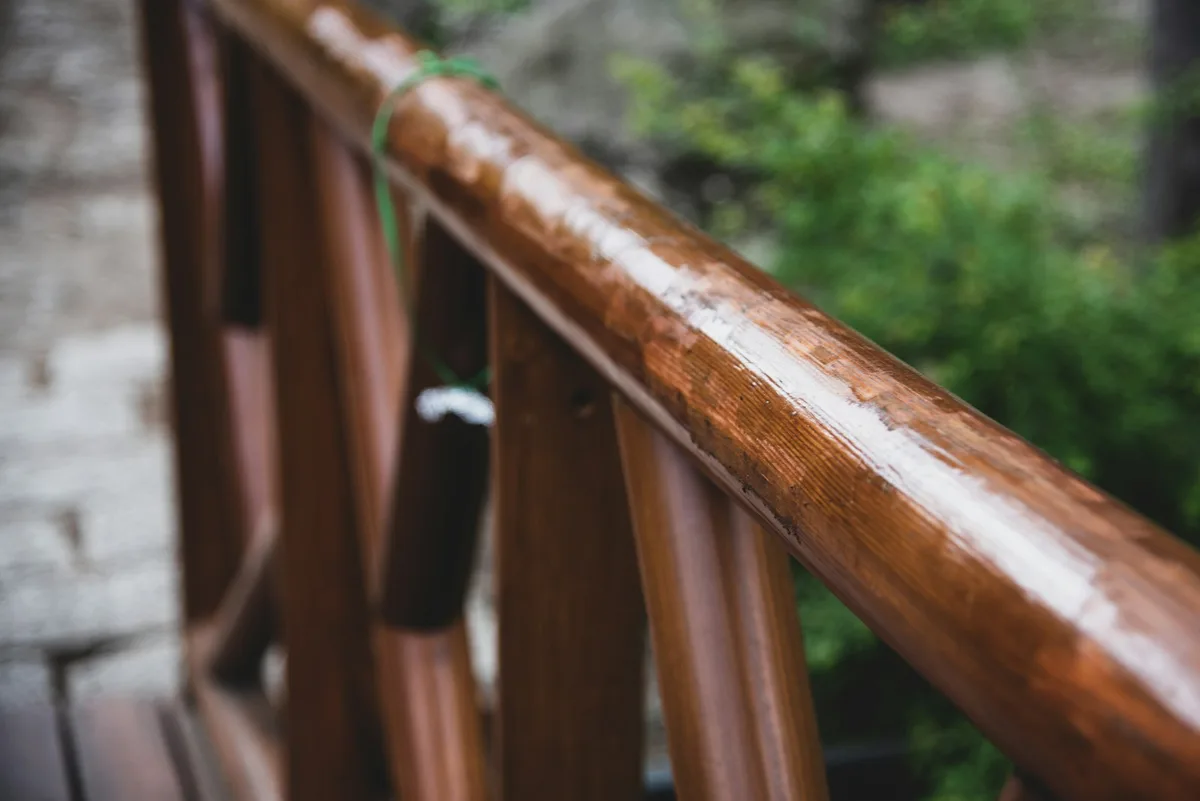
Chippendale and picture-frame panels
Chippendale panels use short diagonal and vertical pieces inside a frame. They read traditional and take a miter saw, a spacing jig and patience. Picture-frame panels, with the infill set inside a border, cost a little more wood and a lot less fiddling.
Horizontal slats and rustic posts
Horizontal slats give the modern look, but the gaps still have to stay at 4 inches or less, so slat width and spacer thickness set the rhythm of the whole rail. Rustic means rough-sawn cedar or log posts weathered grey, or sealed twice if you want the colour to hold.
Be honest about upkeep: wood asks for more than anything else on this list, an annual check of loose balusters and a recoat when the surface stops shedding water.
Metal deck rail ideas
Powder-coated aluminium
deckstore.com lists metal as durable with minimum maintenance, and that is the honest case for it: no recoating, no rot, no checking for soft boards. A powder coat also keeps aluminium from looking the way bare steel does after a few winters, which is why the coated posts turn up in so many photos.
Cable infill
Cable infill between metal posts is the view-friendly pick from deckstore.com's list. Cables need tensioning now and then, so leave access to the fittings rather than burying them behind trim.
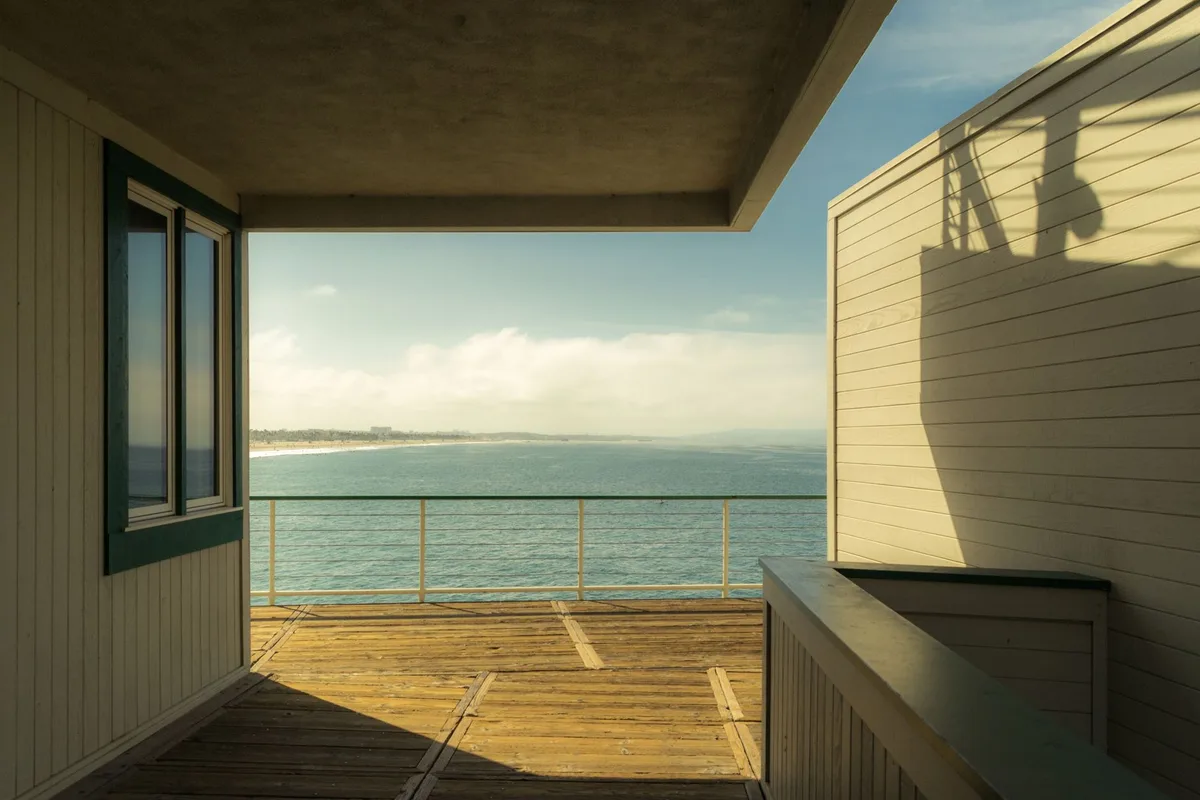
Steel and perforated panels
Perforated or mesh panels block wind and hide what sits behind the rail, at the cost of the view you were keeping. They suit a deck that faces a street or a neighbour's window more than one that faces water.
Doing it yourself
Panel kits arrive pre-drilled and bolt to the posts. The part that decides the result is the post anchor into the deck frame, not the panel. With panels, a level and a second pair of hands, a metal deck railing is a realistic DIY job.
Simple deck railing ideas
Simple wood deck railing ideas
Simple means one top rail, straight posts, one baluster profile, no curves and no cap. Cut one spacer block to the gap and walk it along the rail; even spacing is most of the look, and it costs nothing. Keep the rail line straight by shimming the posts, never by bending the top rail. One colour, and where the deck turns or steps, use a post rather than a joint in the top rail.
The numbers every deck railing has to hit
These are the numbers deckstore.com gives. Measure heights from the deck surface to the top of the rail, on the finished deck, not on the frame.
| What | Number | Where it comes from |
|---|---|---|
| Rail height, residential | 36 in minimum | deckstore.com |
| Rail height, commercial | 42 in minimum | deckstore.com |
| Gap between balusters | 4 in maximum | deckstore.com |
| Top rail | at least 2 in wide by 3 in high | deckstore.com |
| Final say | your local building department | deckstore.com's advice |
deckstore.com also tells readers to check with local authorities first, and that is worth repeating, because local codes amend the numbers. The 4 inch gap applies on stairs and angled sections too, which is where most home-built rails fail. If the deck is close to the ground, the height at which a rail becomes mandatory is a local question: deckstore.com gives the rail heights once one is required, not the trigger height.
The owner's pick: choose by what you see from the deck
If the view is the point
Sit in a chair on the deck and look out. A solid panel at 36 inches cuts more of a seated view than people expect, which is why cable and glass win on view lots.
If wind or privacy is the point
Solid panels, perforated metal and planters block wind and neighbours. Cable and vertical balusters let both straight through.
If kids or dogs use the deck
Horizontal rails are easy to climb. If small children use the deck, keep the infill vertical and the gaps at 4 inches or less. A planter rail is not a climbing aid either, so keep pots away from the top edge.
If you will be the one cleaning it
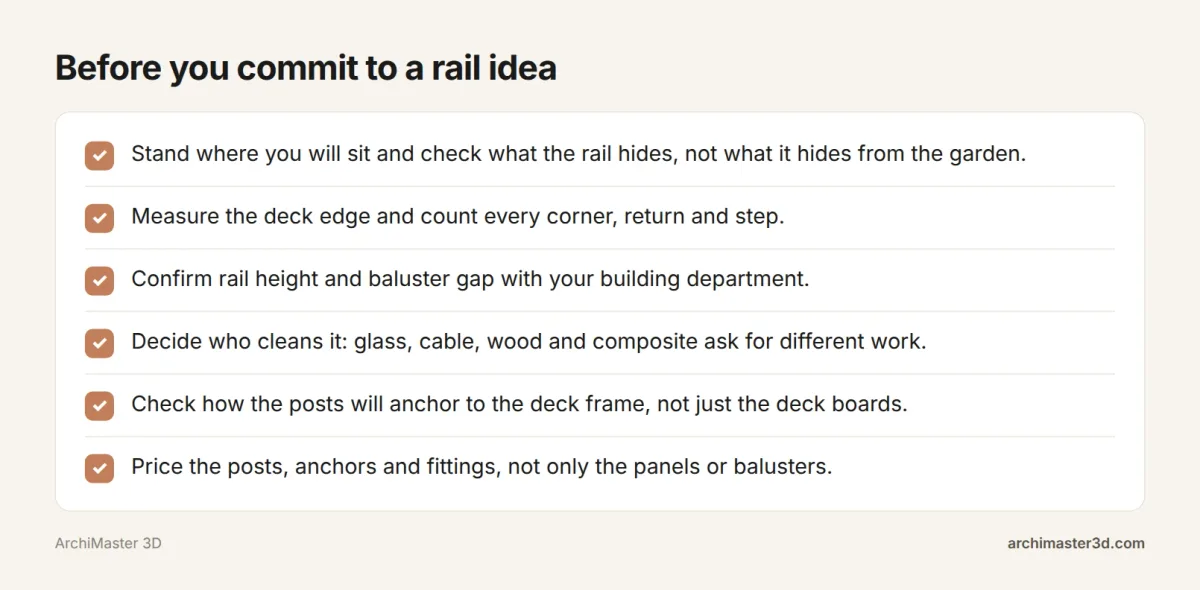
Glass shows pollen and dog noses, cable needs re-tensioning, wood needs recoating, composite and aluminium mostly need washing. Decide who does that before you buy.
DIY deck rail ideas that hold up
What is realistic to build
Wood rails, hog wire panels set in wood frames, and pre-drilled aluminium, composite or metal panel kits. Those four cover most homeowners with a drill, a level and a weekend.
What to leave to a pro
Frameless glass, which is a structural system, and tensioned cable, which needs exact post anchors and a tensioning tool. Both fail badly when they fail.
Order of work
- Set and brace the posts plumb.
- Anchor them to the deck frame, not just the deck boards.
- Run the top rail.
- Fit the infill.
- Add the cap last.
Check every gap with the same spacer before you call the job done, then check the rail height with a tape from the deck surface.
Test the rail on your own deck in 3D
Measure the deck edge and the post positions, draw the deck to scale, place the posts, then try two infills on the same plan. Finish by rendering from the kitchen window and from the garden. Rendering from both sides is the step photos cannot give you: the rail that looks right from outside can cut the view from the sofa.
A 16 by 12 ft deck takes twelve posts: five along each long edge, one at the middle of each short edge. Set the posts first, then the top rail, then the infill.
ArchiMaster 3D's Landscape & Deck edition has a deck and patio wizard, true-to-scale materials, and photoreal renders and walkthroughs made on your own Windows PC, offline. Put cable against wood on your real deck size before you buy anything. See our features, compare pricing, or start the Landscape & Deck free trial for 10 days.
For the rest of the build, plan your ground-level deck and fire pit clearances and your attached vs freestanding pergola in the same file. If the deck will carry a grill and a bar, borrow the layout thinking from our outdoor kitchen layouts.
- What is the cheapest deck railing idea?
- Pressure-treated wood with square 2x2 balusters is the cheapest. Keep the deck edge simple, because every corner and return adds posts, anchors and fittings that cost more than the boards. Skip glass and cable, which push money into hardware and installation rather than lumber.
- What are simple wood deck railing ideas?
- One flat top rail, straight posts and a single baluster profile. Square 2x2 balusters under a 2x6 rail, or wood posts with black metal balusters, are both simple and look deliberate. Cut one spacer block to the gap and use it along the whole run.
- Can I install a metal deck railing myself?
- Yes, with pre-drilled panel kits, a level and a second pair of hands. The panels bolt to the posts, so the job hinges on anchoring the posts to the deck frame, not just the deck boards. Tensioned cable and frameless glass are the two metal options better left to a professional.
- How far apart should deck balusters be?
- No more than 4 inches apart, according to deckstore.com. The same limit applies on stairs and angled sections, which is where home-built rails most often fail. Check every gap with one spacer before you finish the job.
- How tall should a deck railing be?
- deckstore.com puts a residential rail at 36 inches minimum and a commercial rail at 42 inches. Measure from the deck surface to the top of the rail, on the finished deck. Your local building department has the final say, so confirm before you order.
- Which deck railing keeps the best view?
- Cable rail and frameless glass. Both leave the sightline almost clear, and glass also cuts wind. Sit in a chair and look out before deciding, because a solid panel at 36 inches hides more of a seated view than most people expect.
Plan it in 3D before you build: walls, furniture and finishes to scale, then walk through it.
Try it free for 10 days- Who
- Written by Ahmed El Alaoui, editorial direction & marketing analytics at Richdale AI, the company behind ArchiMaster 3D.
- How
- Drafted with AI assistance from the ArchiMaster 3D Landscape & Deck feature set and checked claim by claim against the product fact sheet on Nov 14, 2026. Photographs are stock illustrations, not renders from the software.
- Why
- Help homeowners plan a deck, garden or yard on their own lot so the build matches the plan.
Ready to design with confidence?
See which edition fits the space you’re designing.